

Application of Welding and Machining in Components of Lifting Machinery Equipment
Lifting equipment (cranes, gantry cranes, balance beams, lifting devices, grab buckets, trolleys, legs, drum supports, pulley frames, etc.) extensively use welded structures as raw materials, which are then matched with CNC machining. This is currently the mainstream manufacturing solution in the lifting industry. Compared to pure cast steel parts, it is lightweight, has a short lead time, controllable cost, and is suitable for non-standard customization.

1, Core advantages (compared to castings and forgings)
a. Flexible structure, adaptable to non-standard
Workpieces with variable sizes such as lifting beams, irregular lifting devices, and extended support legs can be welded to freely assemble panels, create variable cross-sections, and reduce weight through hollowing without the need for separate molds. They are suitable for small batch and multi specification lifting and assembly.
b. Controllable weight and matched strength
The board can be arranged according to the force distribution diagram, with thickening in high stress areas and thinning in secondary areas to achieve lightweight; After welding, machining ensures the precision of the fit while balancing the load-bearing capacity and self weight.
c. Short delivery cycle
Eliminating the processes of casting wooden molds, casting, and sand cleaning, thick plate cutting+assembly welding+annealing+machining, faster delivery, suitable for urgent engineering lifting equipment.
d. Easy to detect and repair
Weld seams can undergo UT/MT non-destructive testing; After wear and tear during later use, it can be repaired by welding and re machined to reduce spare parts costs.
e. Cost advantage
The welding machining scheme for large-sized, single piece/small batch lifting parts is much lower than the cost of cast steel and forgings.
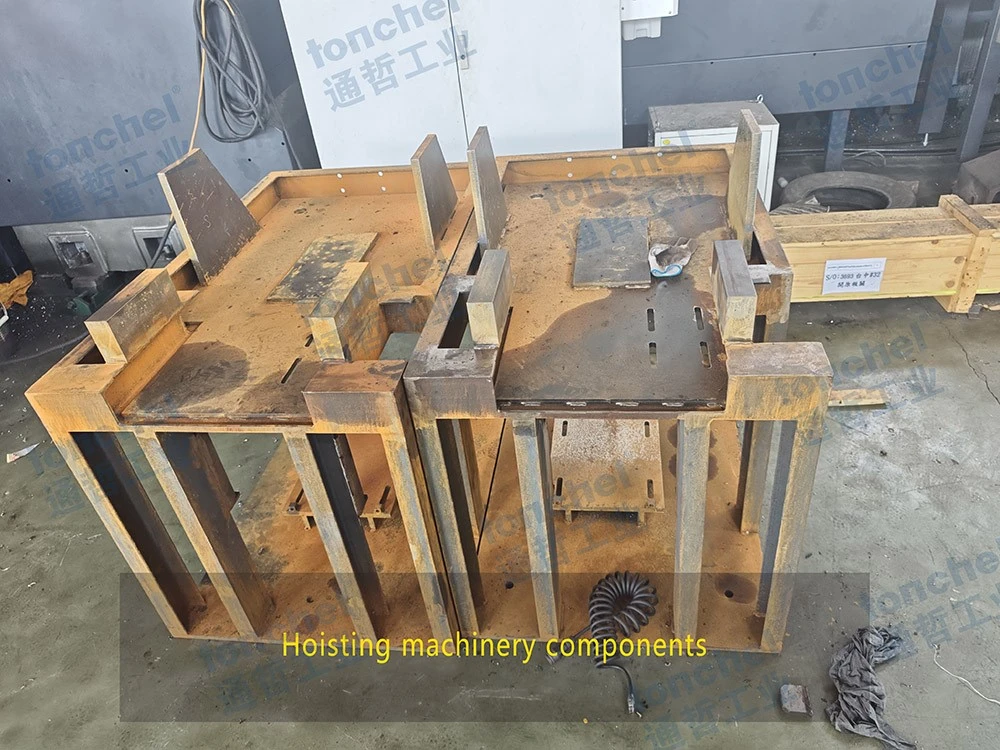
2. Key process quality control points for welding and processing of starting equipment:
a. Welding process
The commonly used materials are Q355B, Q355NL low-temperature plate, and Q690 high-strength plate; Important load-bearing welds shall undergo UT/MT non-destructive testing in accordance with special equipment specifications; Stress relief annealing after welding to eliminate residual welding stress and prevent deformation after machining.
b. Key points of mechanical processing
-Pin hole and bearing hole: boring holes to ensure dimensional tolerance, coaxiality, and roundness;
-Docking flange and fitting reference surface: surface milling to ensure flatness;
-Bolt countersunk: countersunk holes to ensure the fastener fits snugly;
-The stress edges of suspended beams and lifting equipment should be chamfered/rounded to eliminate stress concentration.
c. Inspection
Dimensional inspection, form and position tolerance inspection, non-destructive testing, and load pressure testing (for suspended beam fixtures, rated load and overload load tests are generally required).
