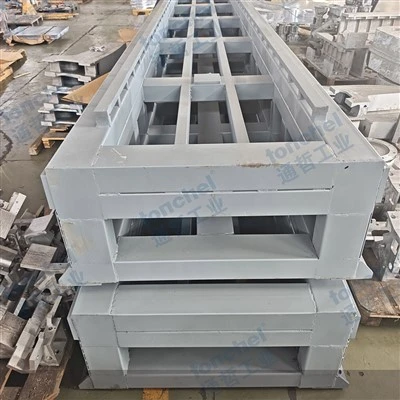
Welding and machining of lifting machinery components
Lifting machinery components refer to various parts, components, and assemblies that make up a crane (lifting equipment). They are the basic components for lifting, moving, braking, and carrying functions of lifting machinery, and are divided into four categories: core load-bearing components, driving components, control components, and safety protection components.
Applicable workpieces & Process combination
Applicable workpieces: lifting structural components, lifting ears, supports, trolleys, drums, leg nodes, lifting beams, pulley supports, bearing seat bases and other lifting components.
Process combination: cutting → forming → welding → post weld treatment → mechanical processing → non-destructive testing → inspection.


Which lifting components are welded and machined?
1. Lifting beam/balance beam.
Process description: After the steel plate is welded and formed, the hinge holes, end faces, and assembly faces are machined.
2. Roll (steel plate roll welding roll).
Process description: The steel plate is rolled into a circular welded cylinder, with flanges welded at both ends, and then the inner hole, outer circle, rope groove, and end face are machined.
3. Small frame, trolley, and walking base.
Process description: Welding frame of profile and steel plate, machining and installation reference surface and bearing seat installation hole after welding.
4. Leg nodes and hinged supports.
Process description: Welding of steel plates, locally thick plates, and drilling of pin holes after welding.
5. Pulley bracket/clamp.
Process description: Thick plate cutting and welding components, machining pulley shaft holes.
6. Buffer base and stopper base welded base.
Process description: Machining and installation of flat surfaces and bolt holes.
Welding+machining process flow
1. Material cutting:
Flame/plasma/laser cutting of steel plates and profiles, chamfering (butt welds, T-joints)
2. Assembly of groups:
Fixture positioning, spot welding fixation, and control welding deformation.
3. Welding:
Commonly used: submerged arc automatic welding, CO₂ gas shielded welding, manual arc welding.
Lifting components belong to load-bearing welds, and important welds shall comply with JB/T and GB/T lifting specifications.
4. Post weld treatment:
Post weld stress relief heat treatment: Remove residual stress from welding to prevent deformation and cracking in later stages (thick plates, high-strength steel, large parts).
Correction: Flame/mechanical correction, controlling flatness and straightness.
5. Mechanical processing:
Milling: milling reference surfaces, flange surfaces, and mating surfaces.
Boring: Boring pin shaft holes and bearing seat holes (with high requirements for coaxiality and aperture tolerance).
Car: drum inner and outer circles, flange outer circles.
Drilling/reaming: bolt holes, locating pin holes.
6. Dimensional re inspection, rust removal, painting/anti-corrosion.

Applicable industry scenarios for lifting machinery components:
Bridge crane, gantry crane, port gantry crane, accompanying crane, tower crane ancillary structural components, lifting equipment assembly; Targeting engineering machinery, port equipment, energy, and ship support.
Hot Tags: welding and machining of hoisting machinery components, China welding and machining of hoisting machinery components manufacturers, suppliers, factory