

Tonchel Industries provides comprehensive solutions for customized castings
Tonchel Industrial has been deeply involved in the field of industrial casting for many years, focusing on customized research and development, production, and supporting processing of various specialized castings for industrial equipment. It has created a one-stop full chain casting solution from demand matching, process customization, blank casting, precision machining to inspection and delivery.
The company can mass produce mainstream metal castings such as cast aluminum and steel parts, and supports two flexible cooperation modes: customized according to drawings and sample replication. The products are compatible with industrial equipment in multiple fields, and with stable product quality, mature production processes, and efficient delivery capabilities, it provides high adaptability and high reliability casting supporting services for equipment manufacturing enterprises in various industries.

1. Core product categories
Tonchel Industrial relies on a mature casting process system and can customize the production of multi material industrial castings according to customer working conditions, loads, and usage environment requirements, covering a full range of products including light and heavy, size specifications, precision, and conventional products.
Cast aluminum parts: lightweight, corrosion-resistant, excellent heat dissipation, high precision, suitable for equipment precision shells, support components, transmission accessories, sealing bases and other components, can meet the needs of thin-walled, complex structure, lightweight equipment, widely used in the field of precision mechanical equipment.
Steel castings: high strength, high toughness, impact resistance, wear resistance, strong load-bearing capacity, suitable for heavy loads, high-strength working conditions, and complex high and low temperature environments. They are mostly used for core load-bearing components such as large equipment load-bearing structures, frames, valve bodies, supports, and beams.
2. Flexible customization service model
Tonchel Industries provides two flexible customization cooperation methods, which can adapt to various scenarios such as new product sampling, mass production, and old part replacement.
2.1 Customized casting based on drawings: Customers provide 2D/3D drawings, and our professional technical team conducts drawing review, structural optimization, and process feasibility analysis. Combined with equipment usage conditions, we optimize the casting process to avoid casting defects such as shrinkage, porosity, and deformation, accurately implement customer design plans, and ensure product size accuracy and performance.
2.2 Sample replication casting: For scenarios where customers have no drawings, old equipment parts are discontinued, imported parts are replaced, etc., we support physical sample surveying, reverse modeling, process replication, 1:1 restoration of product structure, size, and material performance, perfectly adapting to the needs of old equipment maintenance and domestic equipment replacement.
At the same time, it supports full gradient production capacity output for small batch sampling, pilot production, and large-scale mass production. It can flexibly adjust production lines according to customer order requirements, taking into account new product development iterations and large-scale supply needs.

Industry wide equipment adaptation scenarios
Tonchel's industrial casting products are suitable for various fields of industrial equipment, providing targeted solutions to the core needs of load-bearing, wear-resistant, anti-corrosion, and precision assembly of equipment in different industries.
Petroleum Equipment
Suitable for oilfield equipment such as oil extraction, fracturing, cementing, drilling, etc. Customized production equipment includes valve bodies, supports, shells, load-bearing bases, pipeline connectors and other castings. The products are resistant to high pressure and corrosion, and are suitable for complex field conditions in oilfields.
Three coordinate detection equipment
Specially customized for precision measuring equipment, including bases, support frames, fixed bases, and other castings. The product has strong stability, minimal deformation, and high consistency in accuracy, ensuring long-term high-precision operation of the detection equipment.
Testing and Inspection Equipment
Suitable for mechanical testing machines, environmental testing equipment, vacuum testing equipment, sealing performance testing equipment, etc., customized equipment boxes, racks, load-bearing platforms, and sealing castings to meet the strict requirements of high stability, high sealing, and high load of testing equipment.
Woodworking Machinery Equipment
Suitable for various woodworking cutting, polishing, carving, and splicing equipment, producing machine tool frames, transmission housings, counterweights, fixed brackets, and other castings, balancing lightweight and structural strength, and adapting to high-frequency start stop and continuous operation conditions of woodworking equipment.
Ordinary general machinery
covering standard and non-standard castings such as shells, flanges, brackets, bases, transmission accessories, etc. of various general machinery equipment, with strong universality and high cost-effectiveness, meeting the needs of conventional machinery manufacturing and equipment matching.
Large scale machine tool equipment
specializes in heavy-duty machine tool bed bodies, columns, beams, workbenches, large support bases and other oversized castings. The products have strong rigidity, good seismic resistance, stable structure, and can withstand heavy cutting loads, suitable for high-precision machining conditions of large industrial machine tools.
Tonchel Industry provides welding solutions for mechanical components
Tonchel Industries relies on years of experience in metal structure manufacturing and its own casting and CNC precision machining capabilities to provide integrated solutions for non-standard mechanical component welding, cast/cast aluminum welding, dissimilar metal welding, and equipment component welding and repair. Our services cover the entire chain from drawing process review, cutting group matching, welding forming, post weld heat treatment, non-destructive testing to machining and surface protection. We can undertake new batch welding parts, large frame structural parts, and domestic welding transformation of imported spare parts, adapting to the strict load of heavy equipment and foreign trade export quality standards.
1. Weldable materials and product types
1.1 Machinable materials
Carbon steel, low-alloy high-strength steel, stainless steel, manganese steel, chromium molybdenum heat-resistant steel, cast steel parts, aluminum alloy castings (cast aluminum welding), etc
1.2 Core Welding Component Categories
a. Equipment rack, base, crossbeam, support frame, heavy-duty load-bearing bracket
b. Hydraulic/Petroleum Equipment Shell, Valve Body Components, Pipeline Welding Assembly, Fracturing and Cementing Equipment Welding Structural Components
c. Welding and assembly components for wind power, lifting machinery, and woodworking machinery
d. Experimental equipment vacuum chamber, load-bearing platform, sealed welded box body
e. Welding repair of cast steel/cast aluminum blanks, crack repair of castings, welding repair of old equipment components


2. Mainstream welding process
Match welding process based on workpiece material, thickness, load level, and sealing requirements:
MIG/MAG gas shielded welding: High efficiency and controllable deformation for large quantities of structural components.
TIG argon arc welding: for aluminum alloy, stainless steel, thin-walled precision parts, the weld seam is aesthetically pleasing and suitable for sealing components.
Submerged arc welding: Heavy structural components with thick plates, large long welds, deep penetration, and high joint strength.
Manual arc welding: thick and large parts, on-site repair, cast steel and iron repair.
Supporting process: preheating before welding, interlayer temperature control, post weld hydrogen/stress relief annealing, reducing welding residual stress, avoiding cracks, deformation, and fatigue failure.
3. Key application industries
3.1 Petroleum equipment: Welding assemblies for fracturing, cementing, and drilling equipment, high-pressure load-bearing welded components, impact resistant and corrosion-resistant working conditions in the field, and non-destructive testing of welds to meet pressure requirements.
3.2 Wind power equipment: Wind power brackets, bases, connecting structural components, high-strength steel welding, controlling welding deformation, and meeting fatigue load requirements.
3.3 Woodworking Machinery: Machine frame, transmission bracket, weight welding components, high-frequency continuous operation, seismic stability.
3.4 Testing and Inspection Equipment: Vacuum Chamber, Mechanical Testing Machine Rack, Sealed Box, Strictly Control Welding Deformation, Ensure Airtightness and Long term Dimensional Stability.
3.5 General heavy-duty machine tools: bed frame, column, large welded base, reduce residual stress, and ensure long-term accuracy of the machine tool.
3.6 Lifting engineering machinery: lifting lugs, load-bearing arms, connecting supports and other load-bearing welded components.

Tonchel Industries provides solutions for mechanical processing
Tonchel Industry relies on its own casting and welding supporting production capacity to create integrated mechanical processing services including blank preparation, CNC precision machining, heat treatment, testing, and surface treatment. It focuses on precision machining of non-standard heavy equipment components, cast steel/cast aluminum/welded structural parts. Supporting processing based on drawings and samples, covering prototype sampling, small and medium batch production, and large-scale production, providing high-precision finished parts for industries such as petroleum equipment, wind power, woodworking machinery, testing equipment, and large machine tools, which can meet domestic supporting and foreign trade export needs.
1. Machinable blanks and material range
Blank type:
Cast aluminum parts, cast steel parts, ductile iron, gray cast iron, welded assemblies, forgings, profile bars/plates.
Processing material:
Carbon steel, low-alloy high-strength steel, stainless steel, manganese steel, chromium molybdenum steel, aluminum alloy, ductile iron, gray iron, etc.
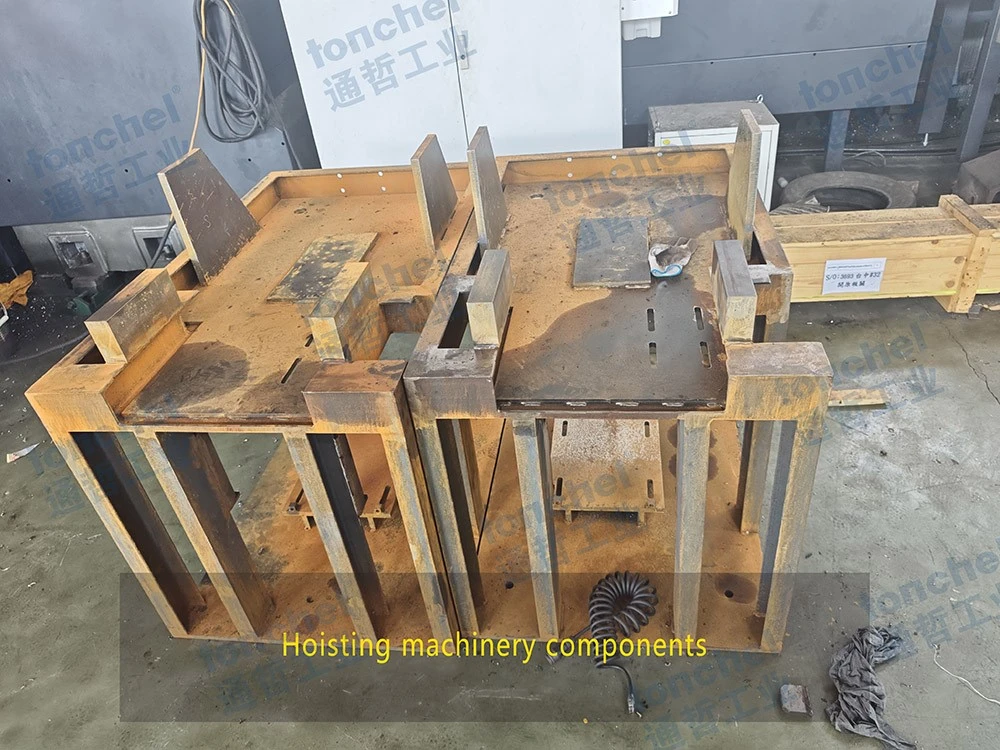

2. Core processing technology and equipment capabilities
2.1 CNC milling processing: Longmen machining center, vertical machining center, can process large machine frames, bases, boxes, valve bodies, and shells, suitable for processing large flat surfaces, porous systems, complex cavities, and sealing surfaces, controlling flatness and positional tolerances.
2.2 CNC turning processing: CNC lathes, large vertical lathes, processing flanges, shafts, sleeves, rotary parts, inner and outer circles, end faces, conical surfaces, thread processing.
2.3 Boring Processing: Floor boring and digital boring machines are used for deep hole boring of box holes, cylinder bodies, and large castings bearing holes to ensure coaxiality and roundness.
2.4 Drilling, tapping, deep hole processing: bolt holes, oil passage holes, NPT pipe threads, special thread processing, suitable for pressure bearing components of petroleum equipment.
2.5 Grinding processing: flat grinding, external circular grinding, to achieve high-precision mating surfaces and reduce surface roughness.
2.6 Supporting processes: deburring, chamfering, heat treatment (annealing, quenching, stress relief), sandblasting, painting, passivation and other surface protection.
3. Typical processed component categories
Oil fracturing/cementing equipment: valve body, shell, flange, pump body, support, high-pressure connecting components.
Wind power equipment: wind power bracket base, connecting flange, load-bearing box body.
Large machine tools: precision machining of machine bed, column, worktable, and guide rail surface.
Woodworking machinery: frame box, transmission seat, counterweight components.
Experimental testing equipment: vacuum chamber shell, testing machine bearing platform, sealed box body.
General heavy-duty machinery: brackets, connecting seats, gearbox housings, various non-standard structural components.

Laser equipment solutions for the household appliance industry
Laser welding machine, as an advanced welding technology, is gradually demonstrating its unique advantages in the field of household appliances, bringing innovative solutions to production and manufacturing.
Laser welding machines use high-energy laser beams for non-contact heating of materials, and achieve high-precision and high-efficiency welding of materials by precisely controlling the position and energy of the laser beam. This welding method has the characteristics of good weld quality, low thermal impact, and small deformation, and is very suitable for the household appliance industry.

Characteristics of laser welding machine:
1. Efficient production line:
Laser welding machines have extremely high welding speeds and can quickly complete a large number of welding tasks. This helps to improve the efficiency of the production line, shorten the production cycle, and meet the rapid demand for household appliances in the market.
2. Precision welding:
Laser welding machines have extremely high precision and stability, and can achieve precision welding of household appliance components. Whether it is small details or large-scale welding, laser welding machines can ensure smooth, continuous, and uniform welds, improving the overall quality and reliability of products.
3. Multi material compatibility:
The laser welding machine is suitable for materials commonly used in various household appliances, such as stainless steel, aluminum alloy, copper, etc. Whether welding the same or different materials, laser welding machines can provide reliable welding results to meet the needs of different product designs.
4. Energy saving and environmental protection:
Laser welding machines generate less heat during the welding process, resulting in less thermal pollution to the environment. Meanwhile, the laser welding machine adopts advanced energy-saving technology, effectively reducing energy consumption and meeting the requirements of sustainable development.
The following are specific application scenarios of laser welding machines in the field of household appliances:
Refrigerator manufacturing
During the refrigerator manufacturing process, laser welding machines can be used for welding between the refrigerator door and the box body. Laser welding can ensure the sealing of the refrigerator door and the stability of the overall structure, improving the insulation effect and service life of the refrigerator.
Washing machine manufacturing
The internal components such as the cylinder and bracket of the washing machine need to withstand high loads of rotation and water flow impact, so high welding quality is required. Laser welding machines can provide high-precision welding, ensuring the stability and durability of the internal structure of washing machines.
Microwave oven manufacturing
The outer shell and internal parts of the microwave oven need to have good sealing and corrosion resistance. The laser welding machine can achieve leak free welding, while the weld seam is beautiful, improving the overall quality and appearance of the microwave oven.
Air conditioning manufacturing
The outdoor and indoor units of the air conditioner need to be connected through pipelines, which must withstand the challenges of high pressure and temperature changes. Laser welding machines can provide high-quality welding, ensuring the sealing and reliability of pipeline connections, preventing refrigerant leakage and performance degradation.
Kitchen appliance manufacturing
Kitchen appliances such as electric ovens, induction cookers, etc. also require welding connections for their internal structure and outer shell. Laser welding machines can provide high-precision welding, ensuring the stability and durability of electrical structures, while also improving the overall quality of electrical equipment through aesthetically pleasing welds.
Small household appliance manufacturing
For small household appliances such as vacuum cleaners, juicers, etc., laser welding machines can also be applied to the welding of their internal parts and shells.
Laser equipment solutions for the automotive manufacturing industry
Laser welding machines, with their high efficiency, precision, cleanliness, and strong adaptability, have demonstrated outstanding application value in multiple key aspects of automotive manufacturing. They not only enhance the safety and durability of vehicles, but also promote the optimization of production processes and cost control. The following points elaborate on the excellent application scenarios of laser welding machines in the field of automotive manufacturing:

1. Body welding
Laser welding machines play a core role in automobile body manufacturing. By using continuous or pulsed laser welding technology, seamless connection of sheet metal components such as doors, roofs, and side panels can be achieved. This welding method not only reduces welding deformation, ensures the strength and rigidity of the vehicle structure, but also makes the vehicle lighter, thereby improving fuel economy and reducing emissions. Especially in the manufacturing of all aluminum car bodies, laser welding has become the preferred technology for connecting materials of different thicknesses.
01
2. Welding of power system components
The manufacturing of power system components such as automobile engines and transmissions also relies on laser welding technology. For example, lasers can be used for welding precision components such as turbocharger blades and fuel injectors, ensuring that these components remain stable and reliable in high temperature and high pressure environments. The high precision and low thermal impact characteristics of laser welding effectively avoid thermal damage and improve the overall performance and service life of the engine.
02
3. Welding of battery pack
With the rise of electric vehicles, laser welding is particularly important in the production of power battery packs. The connection of battery cells inside the battery module and the welding of battery management system (BMS) circuit boards all require laser welding technology. It can ensure precise temperature control during the welding process, avoid thermal runaway, provide reliable electrical connections and sealing, enhance battery safety and extend service life.
03
4. Welding of interior parts and accessories
In the manufacturing of automotive interior parts such as instrument panels, airbag components, seat frames, etc., laser welding technology can achieve perfect welding of complex shapes and thin-walled materials, ensuring the aesthetics and functionality of the components. In addition, laser welding can also be used for fixing accessories such as car window glass and rearview mirrors, providing a secure and aesthetically pleasing connection solution.
04
5. Welding of pipelines and exhaust systems
The automotive piping system, including fuel pipes, cooling water pipes, brake pipes, and components of the exhaust system, can all be efficiently and high-quality welded using laser welding technology. Laser welding can ensure the sealing and durability of these systems under extreme temperature and pressure conditions, enhancing the overall performance and safety of automobiles.
05
Laser equipment solution for advertising decoration
With the increasing demand for personalized customization and the pursuit of high standards for process quality, laser welding machines have become an important tool in the field of advertising billboard production and creative display due to their unique technological advantages. The introduction of laser welding technology not only enhances the aesthetics and durability of products, but also greatly improves production efficiency and the possibility of creative realization. The following provides a detailed discussion on several major application scenarios of laser welding machines in the advertising industry:

1. Precision welding of metal advertising characters
Metal advertising characters, such as letters and logos made of stainless steel, copper, iron, and other materials, require smooth edges, smooth lines, and almost invisible welding points to achieve high-end visual effects. Handheld or specialized advertising word laser welding machines, with their high-precision laser beams, can perfectly fit complex contours and achieve seamless welding. Even the smallest fonts can be accurately welded, and the finished product surface is smooth and traceless, without the need for secondary polishing, directly improving the quality of advertising words.
01
2. Welding of Creative Billboard Structure
Creative billboards often contain complex geometric structures and irregular designs, and traditional welding methods are difficult to meet their precision and strength requirements. Laser welding machines can achieve non-contact welding, reduce the thermal impact on materials, maintain the original shape of structural components, and are suitable for welding and splicing various shaped materials, ensuring that the billboard structure is both stable and beautiful, meeting the creative ideas of designers.
02
3. Processing of thin metal frames
The welding of thin metal structures such as advertising display stands and lightbox frames requires fast speed and minimal deformation. The handheld laser welding machine, with its fast response and concentrated energy output, can complete welding in a short period of time, effectively control thermal deformation, ensure the flatness and strength of the frame, simplify post-processing steps, and reduce overall costs.
03
4. Welding of precision parts and decorative components
In advertising signs and decorations, it is often necessary to weld small precision parts such as LED lamp holders, decorative frames, etc. The precise positioning ability and small spot size of laser welding machines can accurately control the size of welding points, achieve a firm connection of precision parts, while maintaining the original precision and luster of the parts, and enhance the decorative effect.
04
5. Rapid prototyping and customization services
The advertising industry often requires quick response to customer needs, such as sample production or small batch customization. The flexibility and high efficiency of laser welding machines make them an ideal choice for rapid prototyping. Whether it is fine-tuning existing designs or implementing new concepts, high-quality welding operations can be completed in a short period of time, accelerating the process of product design to market.
05
Laser equipment solutions for the steel frame structure industry
In modern architecture and manufacturing, steel frame structures are widely used due to their high strength, light weight, and fast construction. They are ubiquitous in high-rise buildings, bridge engineering, and precision mechanical structures. As a representative of advanced manufacturing technology, laser welding machines have demonstrated unprecedented advantages in the field of steel frame structures, not only improving the stability and durability of structures, but also greatly promoting production efficiency and cost-effectiveness.

The following are the application scenarios of laser welding machines in the field of steel frame structures:
1. Industrial plant
In the construction of industrial plants, laser welding machines can achieve fast and efficient connection of various steel structural components, including steel structure roofs, walls, and supporting structures.
2. Steel structure connection of high-rise buildings
In skyscrapers and other high-rise buildings, steel frames are the key to supporting the entire structure. Laser welding machine can efficiently complete the welding of beam column nodes and supporting frames, ensuring high strength and accuracy of the connection parts. Through continuous laser welding technology, deep penetration welding can be achieved even in the welding of thick steel plates, greatly enhancing the overall stability and seismic resistance of buildings.
3. Welding of bridge steel structures
In bridge construction, laser welding machines are used to weld key components such as bridge decks, trusses, and cable towers. Its high precision and continuous welding capability ensure the uniformity and consistency of the welding area, effectively prevent stress concentration and crack formation, extend the service life of the bridge, reduce structural weight, and lower construction difficulty and cost.
4. Precision mechanical equipment framework
In the frame manufacturing of precision machinery, automated production lines and other equipment, laser welding machines can achieve precise 3D welding and meet the stringent requirements of complex structures. It can weld thin-walled materials without deformation, maintaining the geometric accuracy and surface smoothness of the frame, which is crucial for ensuring the operational accuracy and stability of mechanical equipment.
5. Welding of wind turbine tower
Due to its height and diameter, wind turbine towers require extremely high welding processes. The automated welding system of the laser welding machine can perform continuous welding along the longitudinal and circumferential directions of the tower, which not only improves the welding speed and reduces labor costs, but also ensures the quality of the weld seam and the overall strength of the tower through precise control of welding parameters, which is conducive to improving the operating efficiency and reliability of wind turbines.
6. Welding of offshore platform structures
In the construction of offshore platforms, laser welding machines can effectively address the corrosion challenges of the marine environment. By high-quality welding of steel, strong and resilient welds are formed to resist seawater erosion and wave impact. Especially in key areas such as reinforcing ribs and support columns on the platform, laser welding ensures the durability and safety of the structure, providing a solid foundation for offshore operations.
7. Modular building unit welding
In modular buildings, laser welding machines are used for rapid and standardized production of prefabricated steel structure units. These units are welded in the factory and transported to the site for assembly, greatly reducing the construction period. The high efficiency and precision of laser welding ensure precise docking between modules, improving the overall assembly quality and aesthetics of the building.
Laser equipment solutions for the construction industry
With the continuous improvement of welding quality and efficiency requirements in the modern construction industry, laser welding machines, as an advanced welding equipment, provide innovative solutions for the construction industry.
The following are application solutions for laser welding machines in the construction industry:

1. Efficient and precise steel structure connection
The high precision and efficiency of laser welding machines make them an ideal choice for steel structure connections. Through laser welding, high-quality welds between steel structural components can be achieved, ensuring the overall stability and safety of the structure. Meanwhile, the speed of laser welding is fast, which can significantly improve production efficiency and shorten the construction period.
01
2. Beautiful and durable metal roofs and curtain walls
Laser welding machines play an important role in the manufacturing of metal roofs and curtain walls. Through laser welding, precise connection of metal materials can be achieved, with beautiful and smooth welds, improving the overall appearance quality. Meanwhile, the weld seam of laser welding has good sealing performance, which can effectively prevent leakage and corrosion, and extend the service life of the building.
02
3. Efficient and reliable pipeline system connection
In construction engineering, the connection of pipeline systems is crucial for the transportation of fluids and the normal operation of buildings. Laser welding machines can achieve high-quality connections of various metal pipelines, with strong welds and good sealing, ensuring the stability and safety of the pipeline system. Meanwhile, the high efficiency of laser welding can shorten the pipeline installation cycle and improve the overall construction speed.
03
4. Connection of prefabricated building components
The connection quality of prefabricated building components directly affects the overall performance and service life of the building. Laser welding machines can provide efficient and precise solutions for the connection of prefabricated components. Through laser welding, a firm connection between components can be achieved, improving the stability and durability of the overall structure.
04
5. Automation and intelligent production
Laser welding machines can be combined with automated production lines and intelligent control systems to achieve automation and intelligent production in the construction industry. Through the coordination of automated production lines, continuous operation of laser welding can be achieved, greatly improving production efficiency. Meanwhile, the intelligent control system can precisely control the laser welding process, ensuring the stability and consistency of welding quality.
05